A garden, “a living organism”
In the morning, flowers open to reveal their beauty and "give themselves to the world," only to close in the evening as if going to rest. We can see this far more complex daily movement manifested in vegetation throughout the seasons. We similarly live in our dimension with rhythms and internal movements similar to plants. The vital forces that move within plants are "forces that come from the Cosmos."
The Earth and our plants are closely connected to the Moon, the reflection of the planets, and the Zodiac.
Thanks to the ongoing study of Biodynamics researchers, we can now know the planetary influence on the Earth every day.
More knowledge = more responsibility
The words of men like Gandhi and Kwan-Tsu should make us reflect on how working with nature is part of a moral and responsible ethic toward everything around us.
When you plan for a year,
sow grains of wheat.
When you plan for a decade, plant trees.
When you plan for life, raise and educate men.
Kwan -Tsu
Bio-Dynamics
Biodynamics works by ACTIVATING the Earth's forces through humankind's conscious interaction with the micro and macrocosm and the use of products (preparations) resulting from scientific study.
This introduction does not aim to provide a comprehensive answer to topics requiring in-depth study and experimentation, but rather to offer a first informed contribution to a "Heritage" that belongs to everyone.
THE MOON

Returning to the themes that lead us to relate to the Earth, thanks to those who preceded us, we can now discuss the ascending and descending movements of the Moon.
These movements should not be confused with those of the waxing or waning Moon.
The Moon, in its path, encounters the zodiac signs, moving in its orbit from Sagittarius to Gemini and back, changing its path, tracing a different arc in the sky each day.
In the southern sky, we would see the Moon's path in constant motion, from a small to a large arc.
During the ascendant (peak in Gemini), the plant's sap rises more forcefully, and the plant itself is more vigorous and strong in its aerial apparatus. Forces move more toward the cosmos, and there is a tendency for the Earth to "flow" outward. Earlier, the Earth's breathing was mentioned; at this time, a similarity can be seen with spring-summer, morning/day, and with human exhalation.
This is a good time for cutting twigs for grafting; fruit harvested during this period remains juicier and is suitable for preservation; the essences in bloom will be at their peak.
During the descendant (peak in Sagittarius), the situation is reversed; the plant will have stronger root system.
Forces move more toward the Earth's interior; this similarity will be with autumn-winter, evening/night, and with human exhalation.
This is a good time for sowing, transplanting, mowing, and fertilizing.
Studies in biodynamics provide an inexhaustible wealth of knowledge for humankind's daily interaction with nature.
The study of biodynamics offers an inexhaustible source of reflection and work.
The interaction of the planetary forces of the Zodiac, in relation to the classical elements and the constituent parts of plants, are other aspects of this "path."
Being eco-sustainable while respecting the earth (organic) by interacting with the forces of the macro and microcosmic worlds, strengthening the very strength of the Earth and plants (dynamism).
THE ZODIAC
Throughout the year, the Sun "travels" through the twelve constellations of the Zodiac.
The Moon and all the planets "move" through the constellations and transmit impulses to the Earth. (See Lunar diagram above.)
Plants are influenced by these "forces" from the stars and preserve their "qualities" in their structure, growth, and nutritional substances (carbohydrates, fats, mineral salts, etc.).
THE PLANETS AND THE ELEMENTS
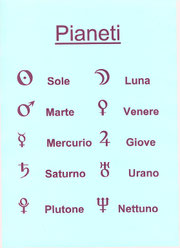
The classical planets: Saturn, Mercury, Pluto – Sun – Jupiter, Venus, Uranus – Mars, Moon, Neptune, are also carriers of the classical elements.
When the planets are found in a constellation that acts through the same elements, the effect is strengthened.
The impulse is almost unnoticed on Earth when the planet is found in a constellation that acts with different elements.
The planets and constellations express their action through the classical elements:
Water – Heat – Earth – Air and with their corresponding plant organs: Leaf – Fruit – Root – Flower.
|
Pianeti e Sole |
Elemento |
Organo Vegetale |
|
Saturno, Mercurio, Plutone Sole Giove, Venere, Urano Marte, Lune, Nettuno |
Calore Terra Aria Acqua |
Frutto Radice Fiore Foglia |
|
Costellazioni dello Zodiaco |
Elemento |
Organo Vegetale |
|
Ariete, Leone, Sagittario Toro, Vergine, Capricorno Gemelli, Bilancia, Acquario Cancro, scorpione, Pesci |
Calore Terra Aria Acqua |
Frutto Radice Fiore Foglia |
The study and fieldwork of Biodynamic scientists has yielded some very interesting insights. The importance of following events beyond the Earth's atmosphere, and applying these events to working with the Earth, is crucial for horticulturists, farmers, and anyone who works with greenery.
Plants can be grouped into four groups:
Fruits – Roots – Flowers – Leaves.
By following a specific plant within its group, from planting and throughout its lifespan, and thanks to the information provided by Biodynamics, we can work with the same natural forces as the plant.
Biodynamics goes beyond this; it also works to ACTIVATE the Earth's forces through the use of products (preparations) derived from scientific study.

TO DESIGN
TO REALIZE